%202.svg)
Nonprofit organization accounting tracks donor restrictions, net assets, and Form 990 reporting. See how it differs from business books, which statements you need, and which method to use.
Nonprofit organization accounting is the system mission-driven organizations use to track, report, and prove stewardship of every dollar, especially restricted gifts from donors and grants.
I’ve kept those books at Compassion, through Switch Consulting, and as a church treasurer. I use the books to show donors, the board, and the IRS where the money went.
A 501(c)(3) that can't show where restricted money went will struggle at grant time and when Form 990 is due.

Nonprofit organization accounting is how a 501(c)(3) records, classifies, and reports money so donors, grantors, and the IRS can see that funds were used as promised. That is what people mean by 501(c)(3) accounting.
Revenue arrives as contributions, grants, program fees, and memberships. Any surplus stays in the mission. The books have to show both where the money came from and what restriction, if any, still sits on it.
If the restriction was never coded when the gift arrived, December is usually when that gap shows up. Someone then has to reconstruct that purpose for grant reports and Form 990.

For-profit books show owners a return. A nonprofit has to show that a restricted gift was used as promised. There are no shareholders. Surplus is not distributed.
Equity becomes net assets, split by donor restriction. Before ASU 2016-14 those classes were unrestricted, temporarily restricted, and permanently restricted. Those three labels now report as net assets without donor restrictions and net assets with donor restrictions.
If a restricted gift is deposited with operating cash and never marked restricted, you can spend it on the wrong purpose and not see it until year-end.
Form 990 is the public filing most tax-exempt organizations submit each year. GAAP statements and the 990 are related, but they are not the same report. Organizations with gross receipts normally $50,000 or less may file Form 990-N. Organizations under $200,000 in receipts and $500,000 in assets may file Form 990-EZ. Above either threshold, the full Form 990 applies.
| Aspect | For-profit | Nonprofit |
|---|---|---|
| Primary goal | Maximize profit | Fulfill the mission |
| Revenue sources | Sales of goods and services | Donations, grants, program fees |
| Equity / net assets | Stockholders' equity | Net assets with or without donor restrictions |
| Income statement | Income statement | Statement of activities |
| Tax filing | Form 1120 or 1065 | Form 990 series |
| Tracking method | Department or cost center | Fund accounting by restriction |
Bookkeeping records the transactions. Accounting turns those records into statements, allocations, and decisions.
A bookkeeper posts the deposit and the invoice. An accountant, or a treasurer doing both jobs, decides whether that deposit is restricted, which function the expense belongs to, and what the board should see.
I see books that code every $3 coffee to its own purpose. Leadership still cannot see meals as one number. One meals account plus a department or class is enough.
Most nonprofits that follow GAAP use accrual accounting. Revenue is recorded when it is earned or promised under the rules, and expenses when they are incurred.
Cash-basis books record money only when it moves. That can work for a very small organization with simple gifts and no audit. It hides pledges, unpaid bills, and restricted balances that accrual would show.
Keep the books on the same cash or accrual method you will use on the statements. If you will need audited GAAP statements, start on accrual before the first grant demands them.

Nonprofits that follow U.S. GAAP prepare a statement of financial position, a statement of activities, and a statement of cash flows under FASB ASC 958. They also present an analysis of expenses by nature and function. That analysis can sit on its own as a statement of functional expenses, on the statement of activities, or in the notes. The longer walkthrough is in the nonprofit financial statements guide.
The statement of financial position is the balance sheet: assets, liabilities, and net assets at a point in time, split by donor restriction.
The statement of activities replaces the income statement and reports the change in net assets for the period.
The statement of cash flows shows cash from operating, investing, and financing activities.
The analysis of expenses by nature and function lays spending such as salaries and rent across program services, management and general, and fundraising.

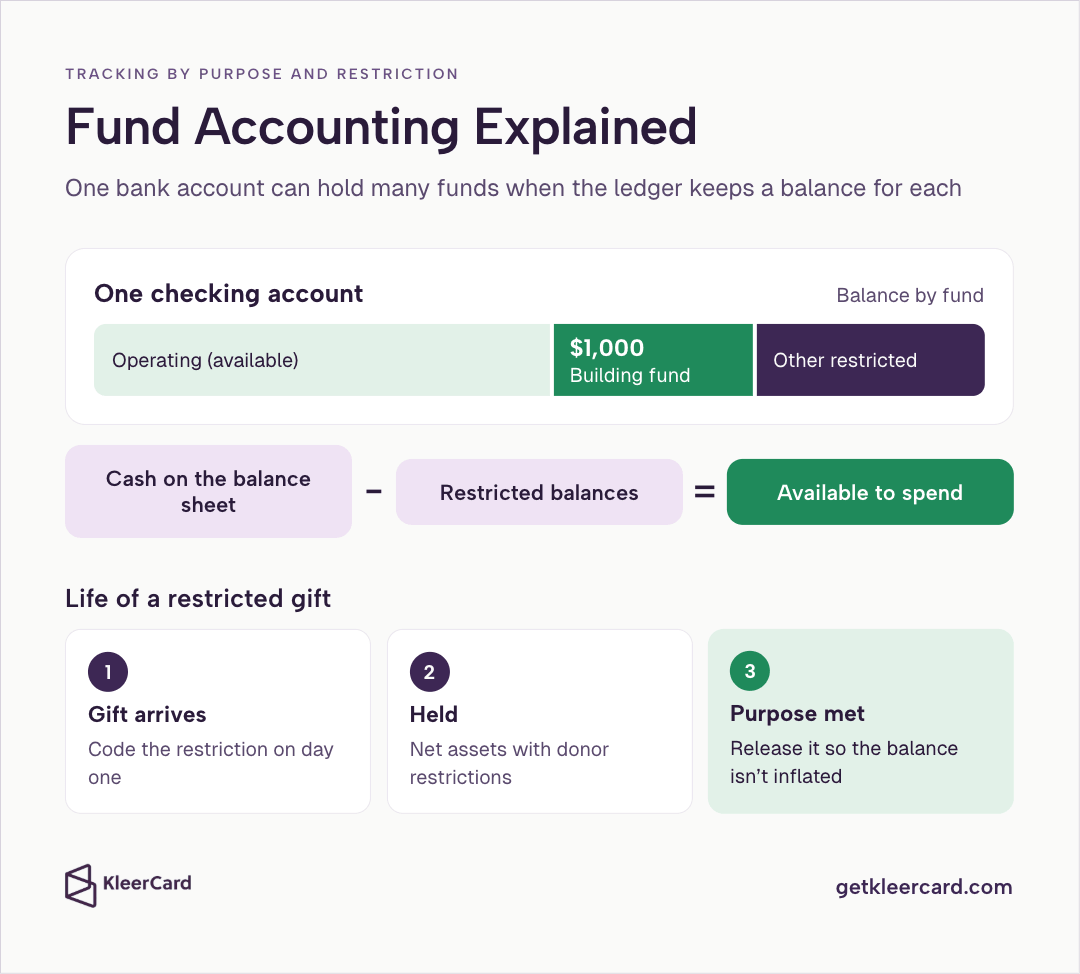
Fund accounting tracks resources by purpose and restriction. A building gift and an unrestricted donation can share a bank account and still follow different rules.
At my church, someone gave $1,000 for the building fund. QuickBooks showed it as cash and as revenue. I could not spend it on rent, benevolence, or anything else. Every month I export the balance sheet and subtract restricted balances in Excel so leadership can see what is actually available.
That export is the workaround for a missing per-fund balance sheet. QuickBooks Online can tag classes and locations. It cannot print a balance sheet for one fund from the software. The longer version of that limit is in why QuickBooks can’t produce a true fund balance sheet.
One bank account can hold many funds if the ledger keeps a balance for each class. Opening a new checking account for every restriction creates board resolutions, new signers, and a donation platform that still posts to one account.
When the purpose is met, the books should release that amount from net assets with donor restrictions. Skip the release and the restricted balance stays inflated after the cash is gone.
The posting steps after a restricted gift arrives sit in how to track restricted funds.
A nonprofit chart of accounts sorts activity into assets, liabilities, net assets, revenue, and expenses. Use a class so you do not invent a new account for every program.
Extra accounts for every ministry meal or classroom supply make a simple total harder. One supplies or meals account plus a class for the program is enough.
The numbered template is in the nonprofit chart of accounts guide.

Nonprofit accounting best practices start with coding restricted gifts when they arrive, not at year-end. Train whoever opens the mail to flag restriction language before the gift hits the ledger.
Reconcile the bank and the funds every month. Compare the budget to actuals in that same monthly review.
Decide functional expense allocations before December. Program, management and general, and fundraising should already be in the books when Form 990 work starts. Keep the chart of accounts small enough that a substitute treasurer can post without a map only you understand.

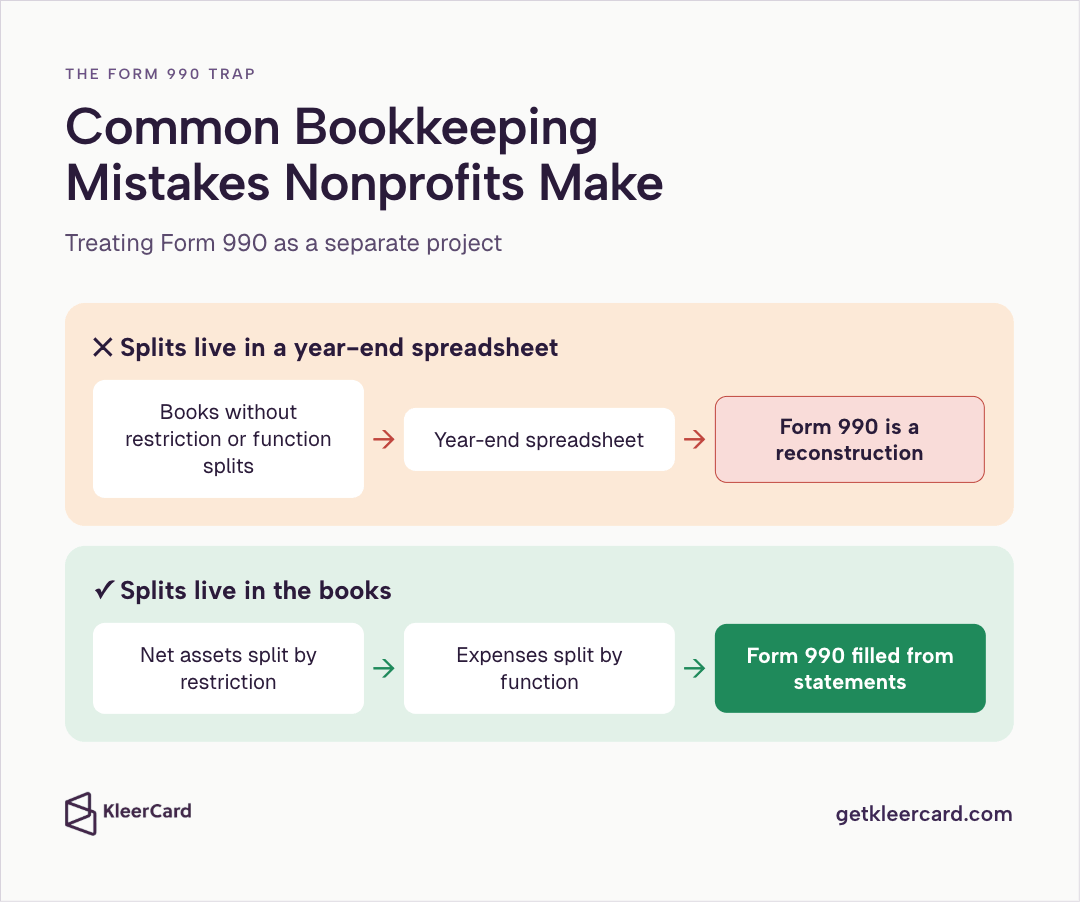
The bookkeeping mistake that still surprises nonprofit boards is treating Form 990 as a separate project. If the books already split net assets by restriction and expenses by function, the 990 can be filled from the statements you already have. If those splits exist only in a year-end spreadsheet, the 990 becomes a reconstruction.
Nonprofit accounting software has to track funds, produce the GAAP statements, and keep restriction classes visible. Familiar tools can do part of that work. Some ledgers can produce a balance sheet by fund without exporting to a spreadsheet.
Prices and product fit are in nonprofit accounting software.


Nonprofit organization accounting is the system a mission-driven organization uses to record, classify, and report money so it can prove stewardship of restricted and unrestricted funds. It follows nonprofit rules under FASB ASC 958 rather than owner-equity reporting.
Nonprofit accounting reports net assets by donor restriction and uses a statement of activities instead of an income statement. For-profit accounting reports equity and profit for owners.
Nonprofits use fund accounting. Money is tracked by purpose and donor restriction, not only by department.
Nonprofits follow GAAP when a funder, state rule, or audit requires it, and many follow it as practice even when the law does not. FASB ASC 958 is the nonprofit-specific guidance.
Accrual accounting is the method that matches GAAP and most grant and audit expectations. Cash-basis books can work for a very small organization and become a problem once pledges, unpaid bills, or restricted funds matter.
Yes — under GAAP, nonprofits prepare a statement of activities in place of an income statement and a statement of cash flows. Both are part of the standard set.
GAAP statements are the statement of financial position, statement of activities, statement of cash flows, and an analysis of expenses by nature and function. That analysis can appear as a separate statement of functional expenses or in the notes.
QuickBooks Online can track classes and locations, but it cannot print a balance sheet for one fund from the software. Many organizations export and subtract restricted balances by hand.
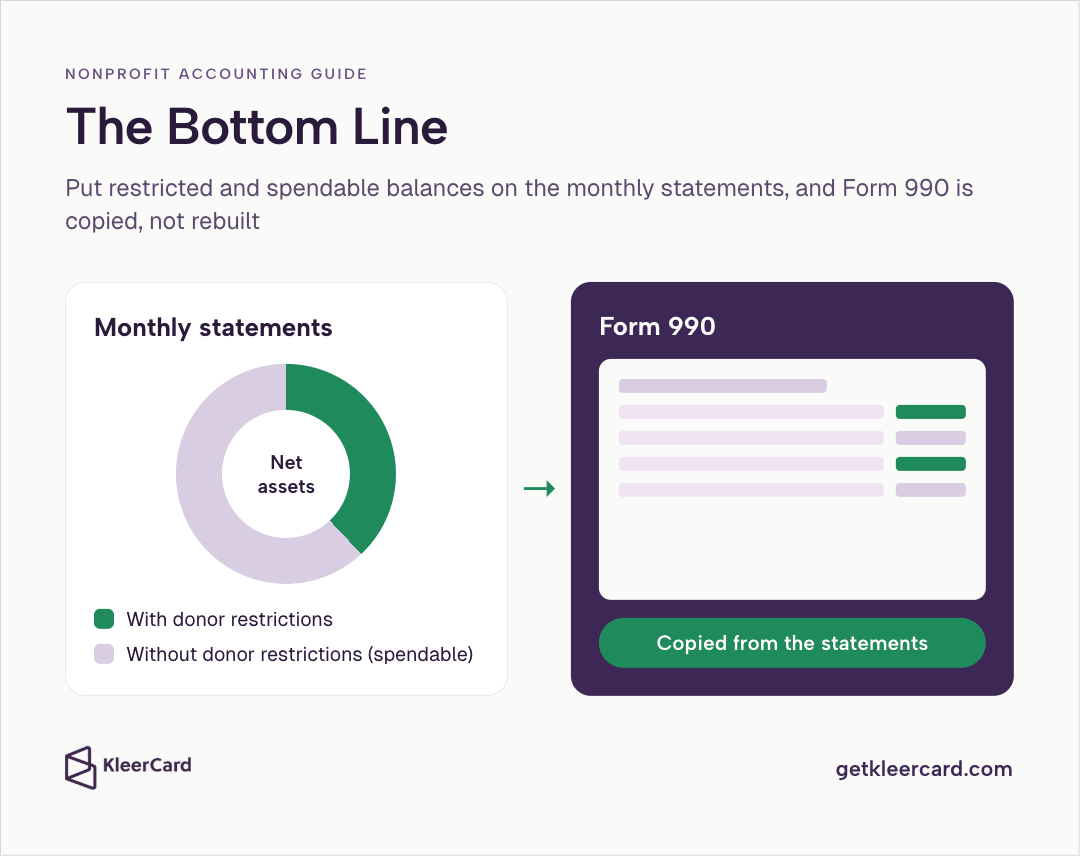
If restricted and spendable balances are already on the monthly statements, Form 990 is copied from those statements instead of rebuilt in a spreadsheet.



Speak to a member of our team and we can have you up and running in minutes, not weeks.