%202.svg)
Track restricted funds from the gift to the release: code donor intent, post spend to the same fund, reconcile monthly, and record the release when the purpose is met.
Imagine this: Your church receives a $25,000 gift for the new youth building. Six months later a cash crunch hits, and someone moves a portion of those funds to cover payroll. Nobody flags it. The books get reconciled at year-end, and the auditor asks where the building money went.
That is a tracking failure. The cash can sit in the same checking account as tithes. The records still have to show what is promised and what is free to spend.
Readers who need the definition of church fund accounting, and the funds most churches keep, should use the church fund accounting guide. This page covers how to post those restricted gifts and the expenses that fulfill them.
I'm Owen Hill, co-founder of KleerCard and treasurer at my church. This is practice, not a CPA opinion.

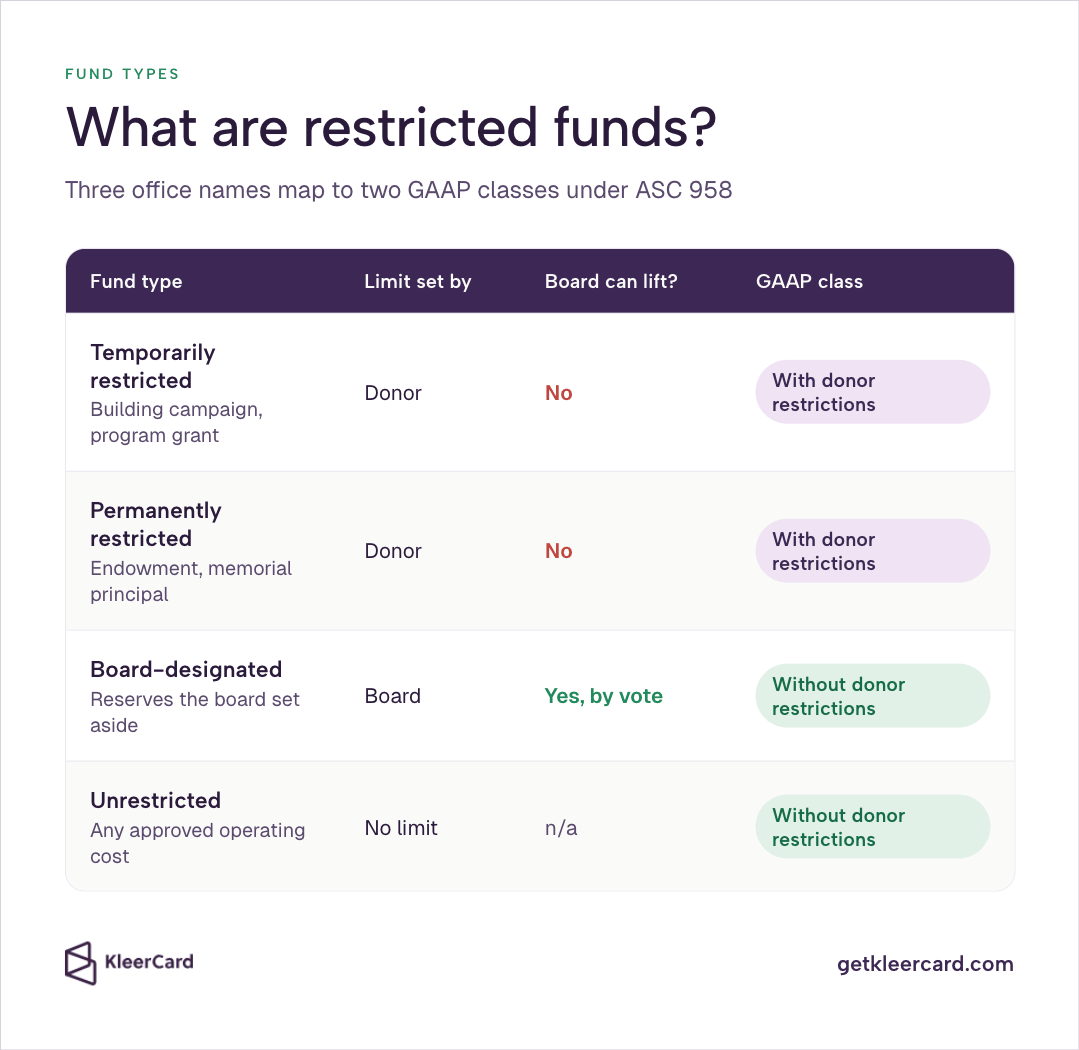
A restricted fund is money a donor or grantor limited to a purpose, a time period, or both. The limitation comes from what the giver said, or from how the church or nonprofit asked for the gift.
Unrestricted funds are different. Leadership can use them for any legitimate operating cost inside the approved budget.
Board-designated funds sound restricted when people talk about them. The board set the limit, so the board can later vote to lift it.
Offices still use three everyday names. Keep them for the people who write the checks. Map them to the two classes FASB ASU 2016-14 requires under ASC 958.
Temporarily restricted funds are the gifts churches see most weeks: a building campaign, a summer program grant, a disaster-relief envelope. Once the purpose is carried out or the time period ends, the remaining amount is released. On GAAP statements these sit inside net assets with donor restrictions.
Permanently restricted funds are meant to be held, often as an endowment or a memorial principal. Earnings may be spendable under the gift terms. The principal stays unspent. These also sit inside net assets with donor restrictions.
Board-designated funds are unrestricted dollars the board voted to set aside. They report as net assets without donor restrictions. A later board vote can retarget them. A donor restriction cannot be lifted that way.
For audit statements, temporary and permanent donor limits collapse into one column: with donor restrictions. Inside the office, keep the separate funds.
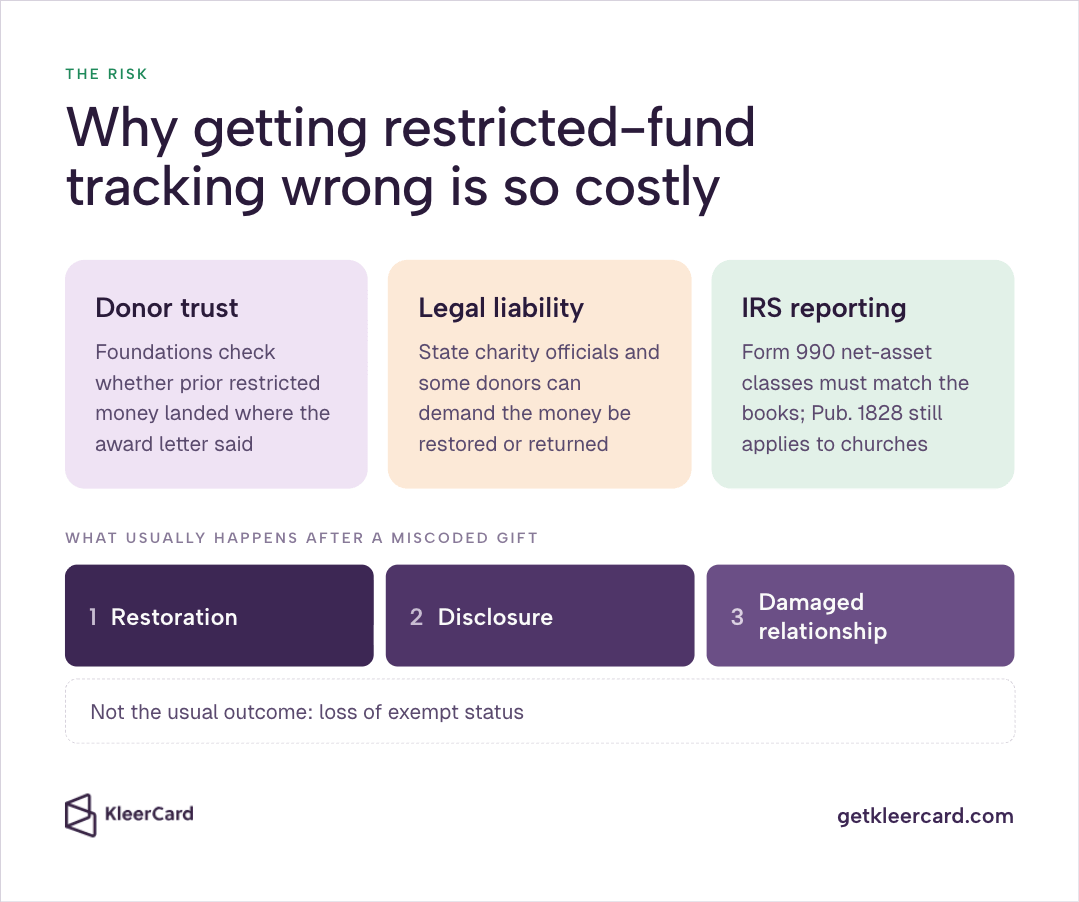
A restricted gift spent on the wrong purpose still has to be restored to that purpose. Misuse is first a donor-intent, audit, and state-charities problem. Loss of exempt status is not the usual outcome of a miscoded gift.
If a scholarship gift covers payroll, the next gift is harder to ask for. Foundations check whether prior restricted money landed where the award letter said it would.
Donor restrictions are enforceable. State charity officials, and in some cases donors, can demand the money be restored to the stated purpose or returned. The usual consequence is restoration, disclosure, and a damaged relationship.
Organizations that file Form 990 report net assets with donor restrictions and net assets without donor restrictions. The Form 990 instructions say those classes have to match the books.
Most churches do not file Form 990. IRS Publication 1828 still tells churches to keep records that support exempt purpose and donor intent.
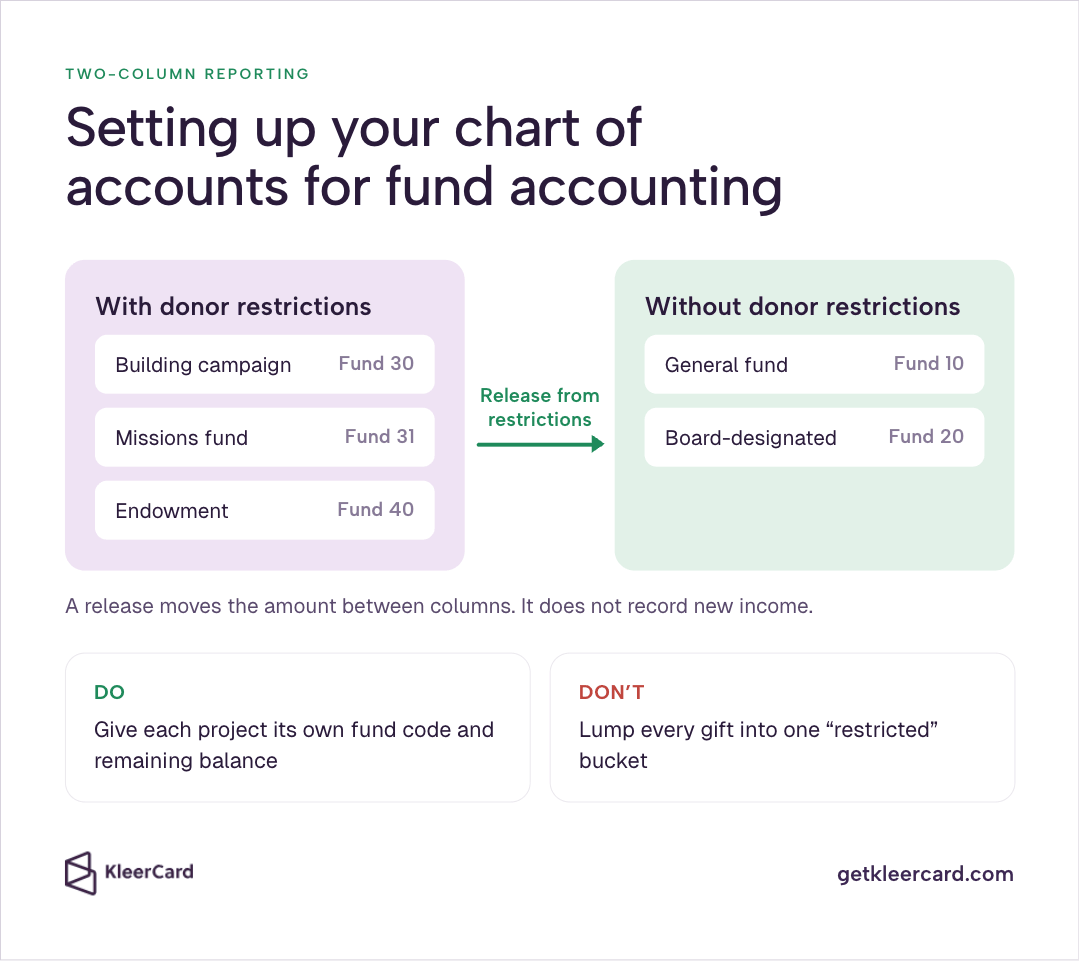
Each restricted fund needs a home the bookkeeper can post to on the day the gift arrives. Create net-asset lines, or fund codes that roll to those lines, for funds without donor restrictions and for each project that has its own remaining balance.
A building campaign, a missions fund, and an endowment should not share one “restricted” bucket if leadership will later ask what is left in each. Do not open a new expense account for every ministry if a fund or class will carry the restriction.
Financial statements should show two columns: with donor restrictions and without donor restrictions. Under ASC 958, nonprofits present those two columns. When the purpose or time is met, a release-from-restrictions line moves the amount from one column to the other. The release does not record new income.
A multi-year grant shows why the two columns matter. If the award has no remaining conditions, the promised amount is usually counted as revenue when the pledge arrives. Without a restricted column, year one looks richer than it is.
QuickBooks Online can tag transactions with classes, but it cannot print a balance sheet for each fund. Churches that run QBO and need that report should read why QuickBooks can’t produce a true fund balance sheet.
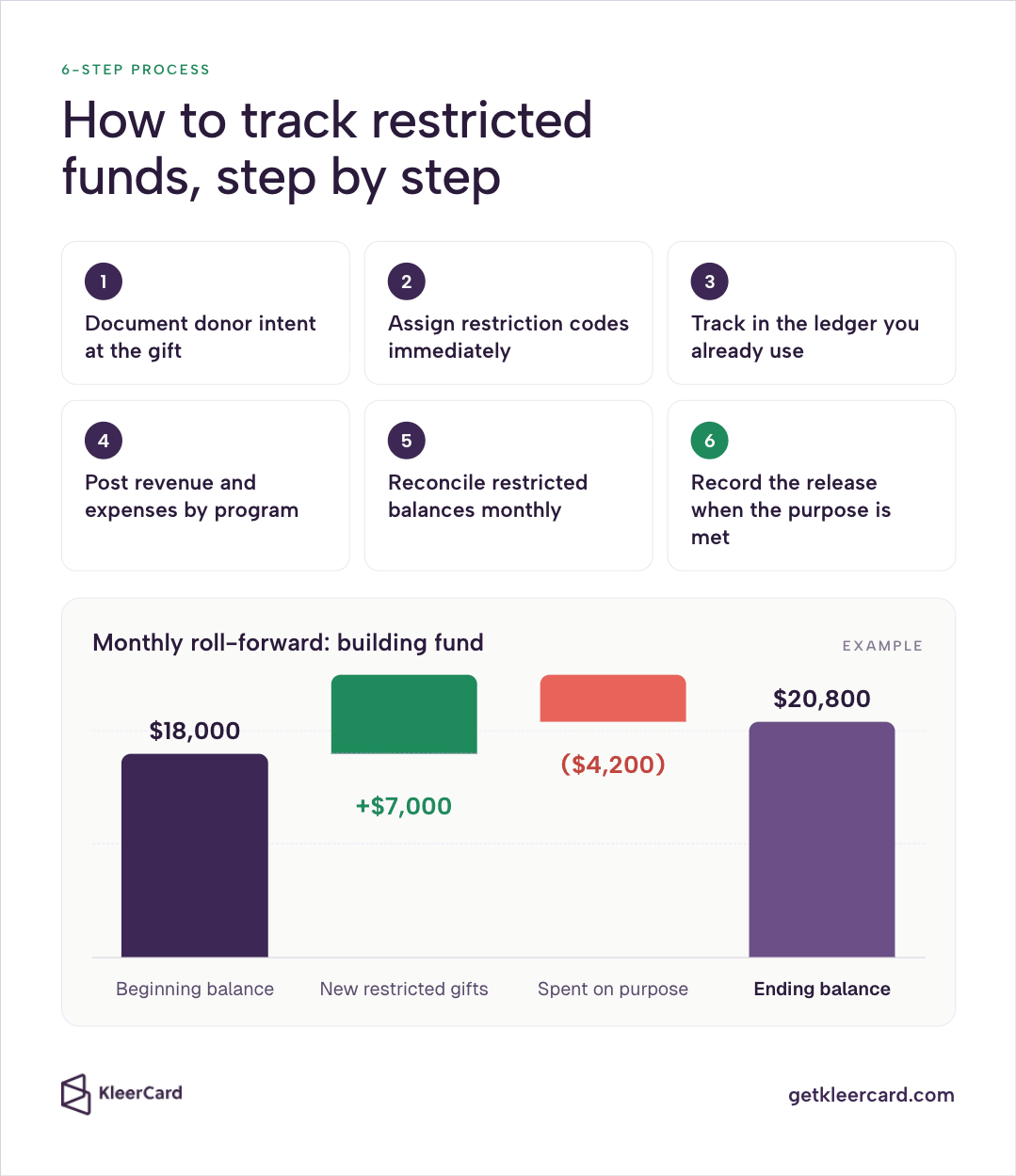
How do you track restricted funds in a church or nonprofit? Document donor intent at the gift, code the restriction before it hits the ledger, post revenue and expenses to that fund, reconcile the remaining balance every month, and record a release-from-restrictions entry when the purpose or time is met.
The report that proves it is a short roll-forward for each restricted fund:
| Building fund example | |
|---|---|
| Beginning restricted balance | $18,000 |
| Additions (new restricted gifts) | $7,000 |
| Releases (spent on the stated purpose) | ($4,200) |
| Ending restricted balance | $20,800 |
That ending number should match the net-asset line for the fund.
Restrictions show up on check memo lines, online giving notes, pledge forms, emails, and verbal instructions at the office window. Flag that language before the batch is posted.
If the intent was spoken, follow up in writing. A short email that restates the purpose is enough.
Once the gift is restricted, it needs a code before it enters the general ledger. Not at month-end.
Assign the program, project, or restriction code at entry so later expenses can land on the same code. Recoding a quarter of deposits after the fact is how funds get commingled.
Purpose-built fund accounting tools give each restricted fund its own balance. Classes, locations, or project tags plus a roll-forward approximate the same job. A small church with two restricted funds can keep that roll-forward in a spreadsheet if every transaction still carries a fund.
Do not post a gift or an expense without a fund. Compare church-specific ledgers in the church accounting software guide.
Restricted-fund tracking has to follow the dollar out to the invoice that fulfilled the purpose.
Post the building-campaign gift to the building fund. Post the contractor invoice to the building fund too. If payroll or rent is split across a grant and the general fund, split it when you post it.
Year-end is too late to reconcile restricted funds. Each month, for each restricted fund, tie beginning balance plus gifts minus releases to the ending net-asset line.
A negative restricted balance means the fund was overspent or a transaction landed on the wrong code. Fix it in the month you find it.
When the purpose is carried out or the time period ends, record the release. Move the amount from net assets with donor restrictions to net assets without donor restrictions on the release-from-restrictions line.
Keep the evidence with the entry: the completed project, the grant period ending, or the donor’s written release. Skip the journal entry, and the restricted balance stays inflated after the cash is gone.
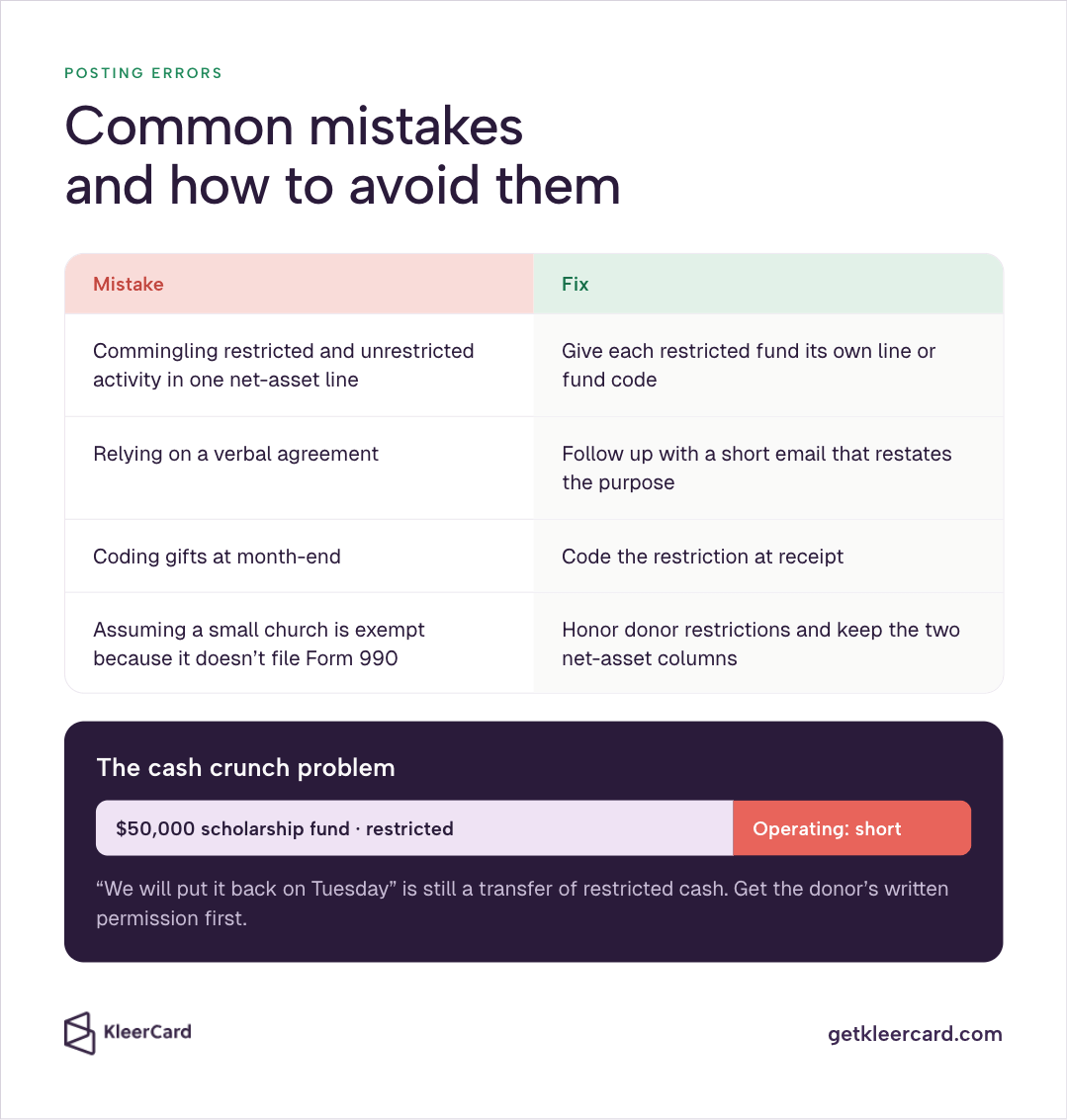
Most restricted-fund errors are posting errors: the gift was coded late, posted to the general fund, or spent because the checking account looked healthy.
The common errors are commingling restricted and unrestricted activity in one net-asset line, relying on a verbal agreement with no written follow-up, coding gifts at month-end instead of at receipt, and assuming a small church is exempt from the two net-asset columns (with and without donor restrictions) because it does not file Form 990.
Once a gift is restricted, it cannot cover payroll just because the operating account is short. Sitting on $50,000 in a scholarship fund while the operating account cannot cover next week’s salaries does not make the scholarship money available. “We will put it back on Tuesday” is still a transfer of restricted cash. It needs a record, and in most cases it needs the donor’s written permission first.
If the situation is serious enough to retarget the gift, ask the donor in writing before the money moves.

A church or nonprofit that tracks restricted funds can send the donor a short quarterly note with the beginning restricted balance, what was spent on the stated purpose, and what remains. If that purpose has to change, ask the donor in writing before you reclassify the gift.

Campaign language often creates a restricted fund before anyone signs a gift agreement.
A campaign that says “Give to our new sanctuary” treats the gifts that arrive as restricted to that sanctuary. A campaign that says “Give to support our ministry’s needs, including our new sanctuary” leaves leadership more room. Review envelopes, giving pages, and pledge forms before they go out so the books are not stuck tracking a restriction nobody meant to create.
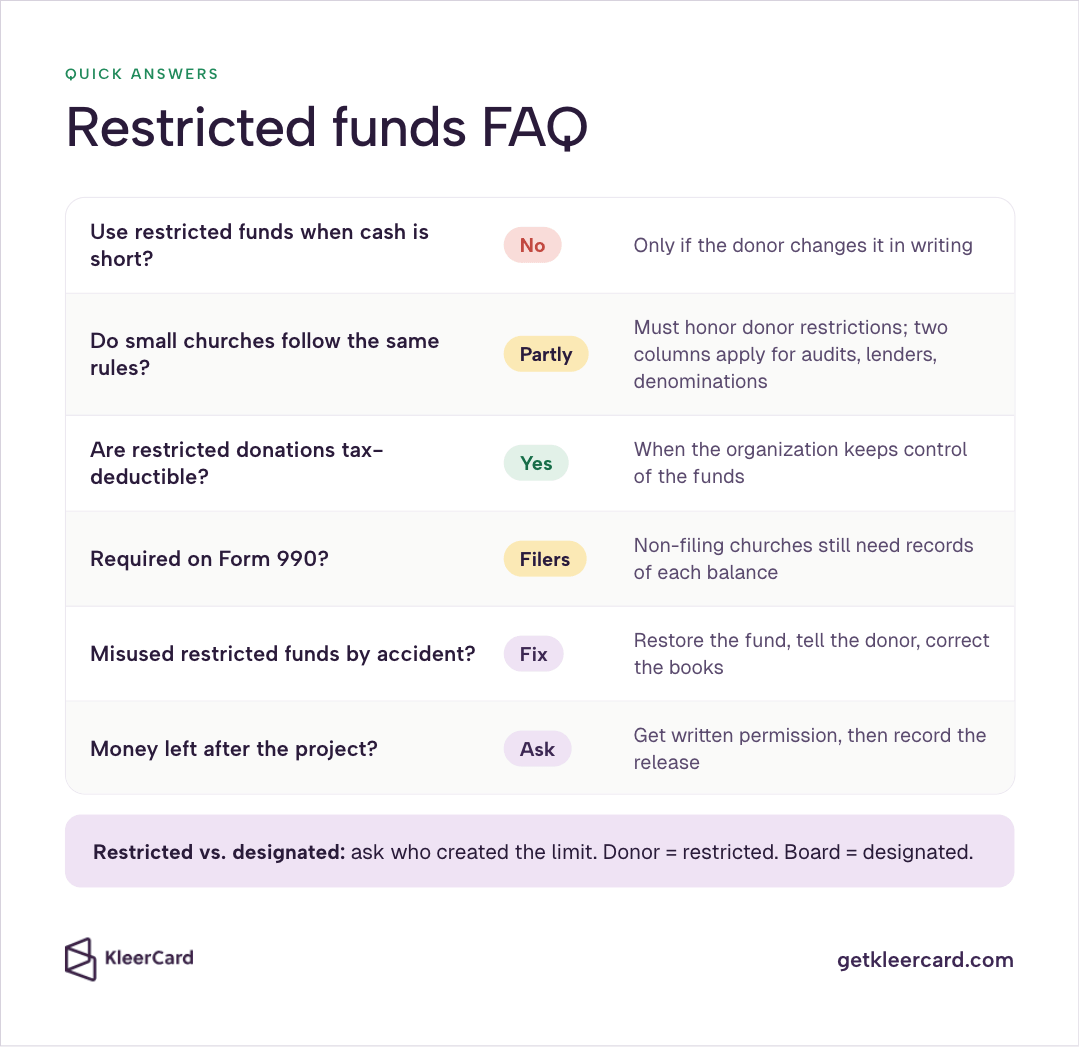
Restricted funds are limited by the donor; designated funds, in everyday church use, are often board-set reserves the board can later vote to release. Ask who created the limit.
No. Restricted funds cannot be moved to cover general operations unless the donor lifts or changes the restriction in writing.
Small churches still have to honor donor-restricted gifts. Statements that split net assets with and without donor restrictions apply when the church issues them for an audit, a lender, or a denomination.
A purpose restriction does not, by itself, cancel the donor’s charitable deduction. IRS Publication 526 still treats a gift to a qualified organization as deductible when the organization keeps control of the funds. The deduction is the one that fails when the gift is earmarked so tightly that the organization is only an agent for a named person.
Restore the restricted fund from unrestricted cash, tell the donor, and correct the books.
Ask the donor for written permission to reallocate what is left. If the donor agrees, reclassify the remainder and record the release on the statement of activities.
No for churches that do not file Form 990. Organizations that file report net assets with donor restrictions and net assets without donor restrictions on that form. Churches that do not file still need records that show each restricted balance.
For the fund structure around restricted-fund tracking entries, use the church fund accounting guide.


Speak to a member of our team and we can have you up and running in minutes, not weeks.