%202.svg)
Church fund accounting tracks money by purpose, not profit. See fund types, setup, reports, and how churches keep restricted gifts from looking spendable.
Church fund accounting is how a church keeps a separate balance for the general fund, missions, benevolence, and a building project even when all the cash sits in one checking account. Tithes and a designated gift can land in the same deposit and still have to be tracked as two balances.
I keep the books at my church. At St. John’s, a member gave $1,000 restricted to the building fund. The gift showed up as cash and as profit. It could not pay rent or a missions bill. Each month I export the balance sheet and subtract every restricted balance so leadership can see what is actually free to spend.
This is why we're launching our own church fund accounting platform. To solve problems no other software offers right now.
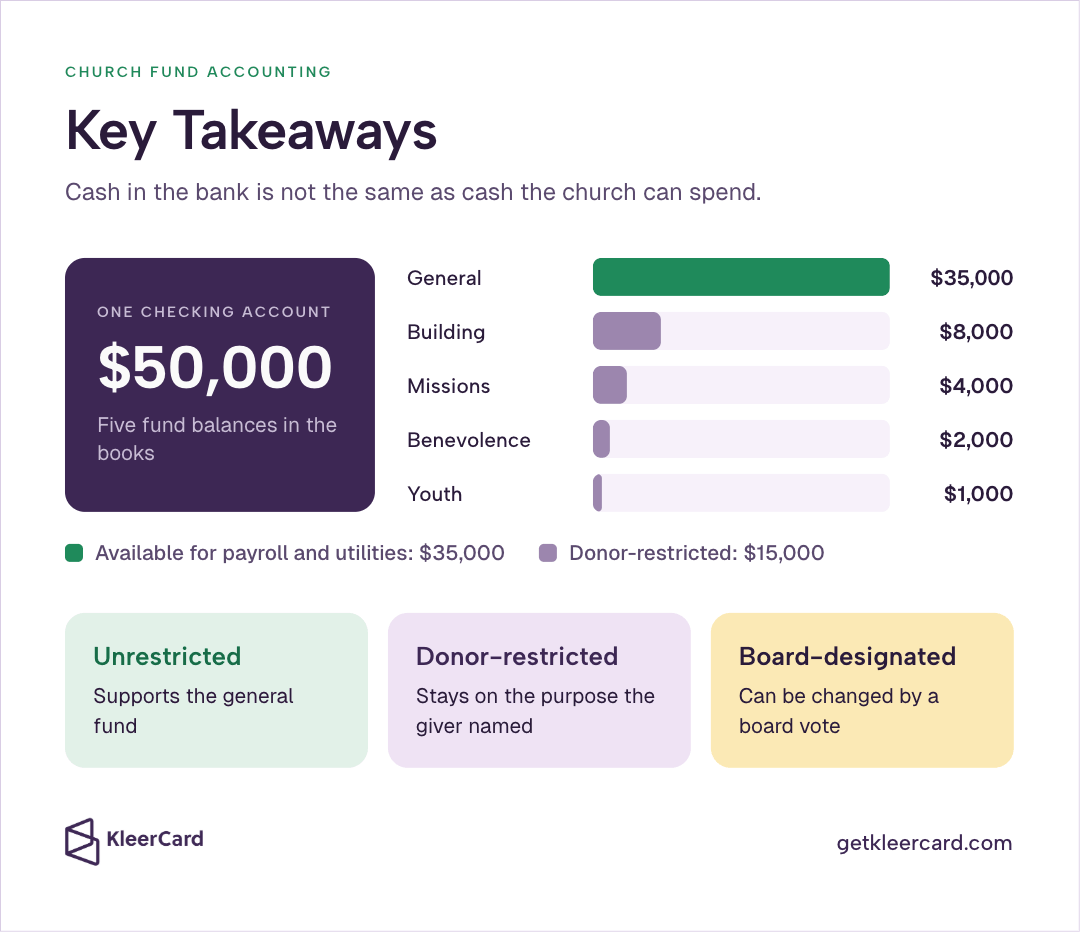
Church fund accounting tracks each gift and each expense against the purpose it belongs to, so the general fund, a missions fund, a benevolence fund, and a building fund keep separate balances. The cash can live in one bank account. The books still show which dollars are free for operations and which dollars are already committed.
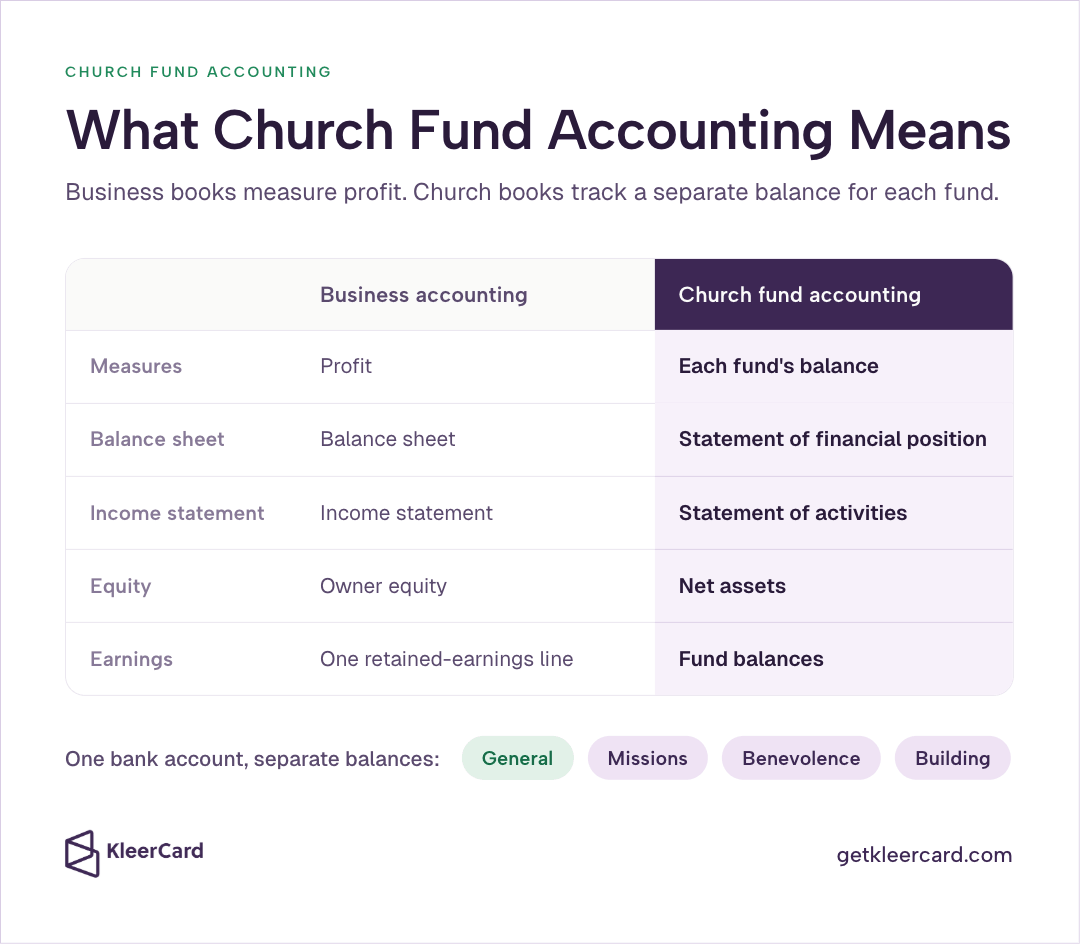
Business books measure profit. Church books have to show whether a building gift is still sitting in the building fund and what the general fund can actually cover.
Churches still produce a balance sheet and an income statement, usually titled a statement of financial position and a statement of activities. Net assets take the place of owner equity, and fund balances take the place of a single retained-earnings line.
Most churches do not need dozens of funds. They need a short list that matches how people actually give.
FASB ASU 2016-14 reduced formal reporting under ASC 958 to two net-asset classes: without donor restrictions and with donor restrictions. Older statements used “temporarily restricted” for purpose or time limits and “permanently restricted” for endowments. Those balances now sit inside net assets with donor restrictions. Building fund and missions fund are names for money that already sits in one of those two classes.
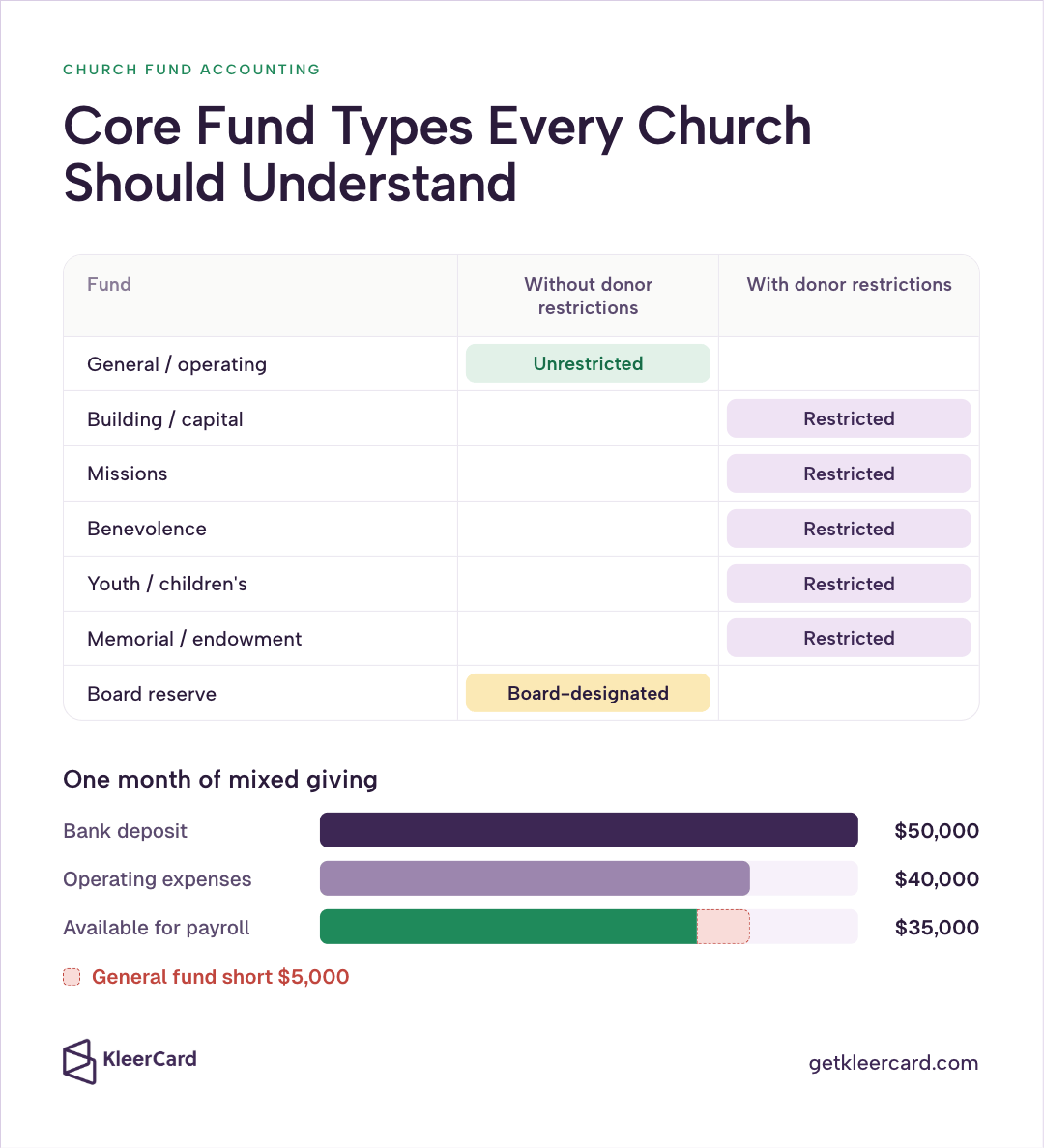
| Fund | Typical purpose | How it is classified |
|---|---|---|
| General / operating | Payroll, utilities, insurance, routine ministry | Unrestricted (without donor restrictions) |
| Building / capital | Construction, renovation, mortgage principal | With donor restrictions |
| Missions | Missionaries, trips, outreach partners | With donor restrictions |
| Benevolence | Help for members and neighbors | With donor restrictions |
| Youth / children’s | Camps or curriculum bought from designated gifts | With donor restrictions when the giver limited the use |
| Memorial / endowment | Principal kept, income used as the gift allows | With donor restrictions |
| Board reserve | Future equipment, cash reserve, capital set-aside | Board-designated, still unrestricted |
A month of mixed church giving makes restricted versus unrestricted cash easier to see.
| Source | Amount | Fund | Available for payroll and utilities? |
|---|---|---|---|
| General tithes and offerings | $35,000 | General / unrestricted | Yes |
| Building campaign gifts | $8,000 | Building / donor-restricted | No |
| Missions offering | $4,000 | Missions / donor-restricted | No |
| Benevolence envelope | $2,000 | Benevolence / donor-restricted | No |
| Youth camp gifts | $1,000 | Youth / donor-restricted | No |
| <strong>Bank deposit</strong> | <strong>$50,000</strong> | <strong>Only $35,000</strong> |
If operating expenses that month are $40,000, the general fund is short $5,000 even though the bank went up $50,000.
Unrestricted funds are gifts leadership can use inside the approved budget. Weekly tithes and offerings usually land here. This is the pool that pays payroll, utilities, and ordinary ministry costs.
If unrestricted giving drops, the church can struggle to cover operations while restricted funds still look healthy. The monthly reports have to show that split.
Restricted funds are limited by the giver. A missions gift stays in missions. A scholarship stays in scholarships. A building-campaign gift stays in the building fund.
The restriction comes from what the donor said, or from how the church asked for the gift. Moving that money to payroll, even with a plan to put it back, breaks the promise and leaves a cleanup the board has to unwind.
Churches that need the posting steps for those gifts can use the guide on how to track restricted funds.
Board-designated funds are unrestricted dollars the board voted to set aside, such as a reserve for a new roof or a future hire.
The board can later vote to release or retarget that reserve. A donor restriction cannot be lifted the same way. Calling a board reserve “restricted” hides cash the church is allowed to spend.

A church fund accounting system starts with the funds, the account list, and the naming rules, written down before the next batch of gifts is posted. A volunteer treasurer can maintain a short structure. A long fund list falls apart the first week the usual person is out.
Keep the usual five groups: assets, liabilities, net assets, income, and expenses. Show the fund in the net-asset accounts and on each gift and expense. Do not open a new expense account for every ministry if a fund or a department tag will do the same job.
A youth purchase of curriculum is still a curriculum expense. The fund tells you whether general-fund money or a restricted camp gift paid for it. The church accounting guide includes a fuller sample list.
Write down when a new fund may be opened, merged, or closed. Use the same name the giving envelope and the online form use. If members give to “Building Expansion,” the books should not call it “Capital Reserve 3” unless both names appear together.
Add who can approve a transfer, who can post a journal entry, and what happens when a restricted project finishes under budget. Those three rules prevent most cleanup work later.
Some church tools produce a balance sheet by fund. Others need a monthly export. Compare options on the church fund accounting software page.
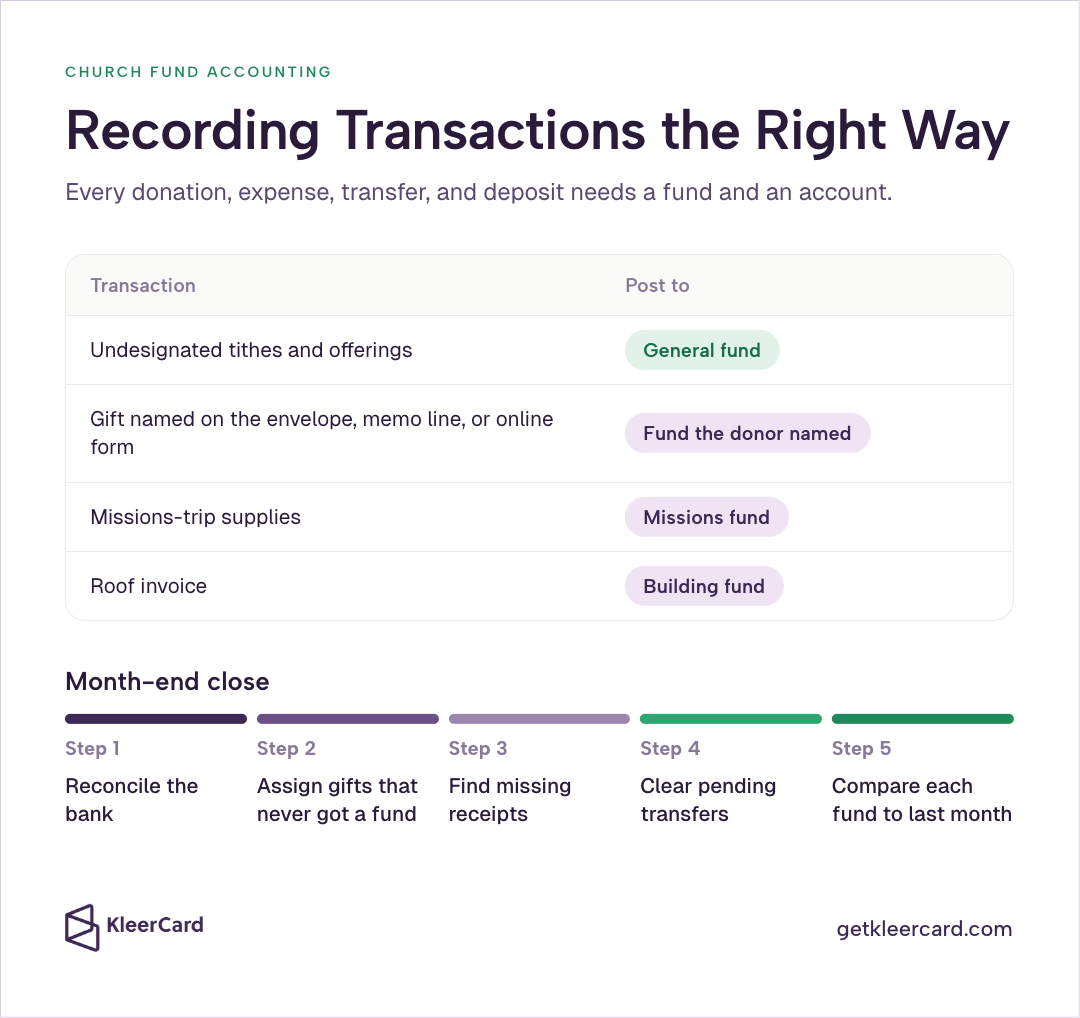
Church books need a fund and an account on every donation, expense, transfer, and deposit before the transaction is recorded.
Post undesignated tithes and offerings to the general fund. Post a gift to the fund the donor named on the envelope, the memo line, or the online form.
Match the books to what the giver actually said. Year-end contribution statements should stand on that same posting. IRS Publication 1828 is the federal reference churches use for recordkeeping and written acknowledgments.
Charge the expense to the fund that is paying for the work. Missions-trip supplies come out of missions. A roof invoice comes out of the building fund.
When restricted money is spent on its purpose, the books should reduce that fund’s balance. Under GAAP, churches often record that reduction as a release from net assets with donor restrictions. Skip the journal entry, and the restricted balance stays inflated after the cash is gone.
Reconcile the bank every month. Then review fund balances, not only the cash total. Look for gifts posted to the general fund that were marked “building” on the memo line, and for expenses that landed in the wrong fund.
A short close is enough: bank reconciliation, gifts that never got a fund, missing receipts, pending transfers, and a scan of each fund balance against last month.
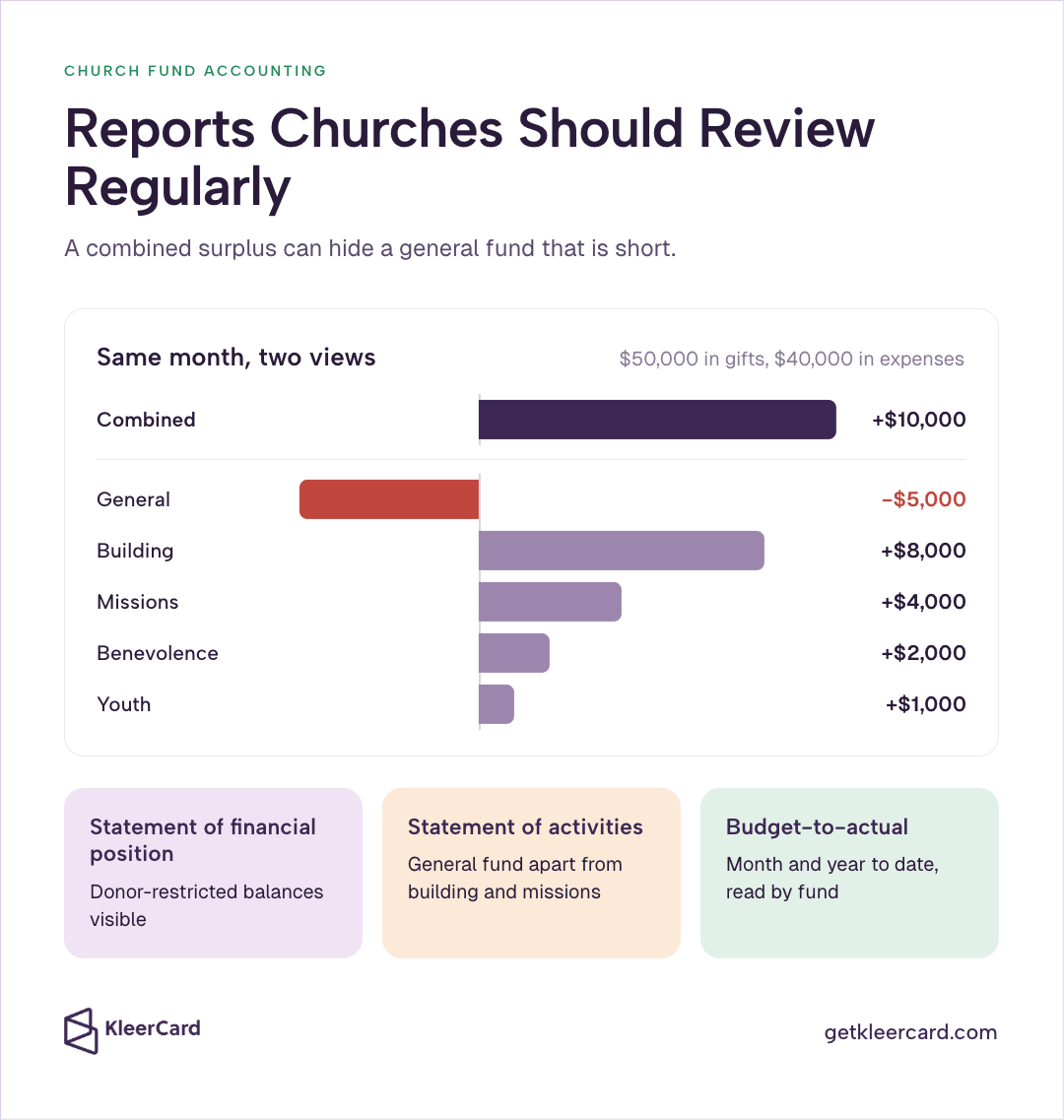
Church monthly reports should show whether payroll is covered, whether restricted balances are still right, and which ministries are off plan.
The statement of financial position is the church’s balance sheet. It should show assets, liabilities, and net assets, with donor-restricted balances visible.
The statement of activities is the church’s income statement. It should show gifts and expenses for the period, with enough fund detail that a reader can see the general fund move separately from building and missions.
If those reports only show one combined surplus, the board cannot see how the general fund moved.
A budget-to-actual report compares the plan to the month and the year to date. Read it by fund, not only by the whole church.
An underspent youth line can mean the retreat moved to next quarter. It can also mean designated camp money never got used.
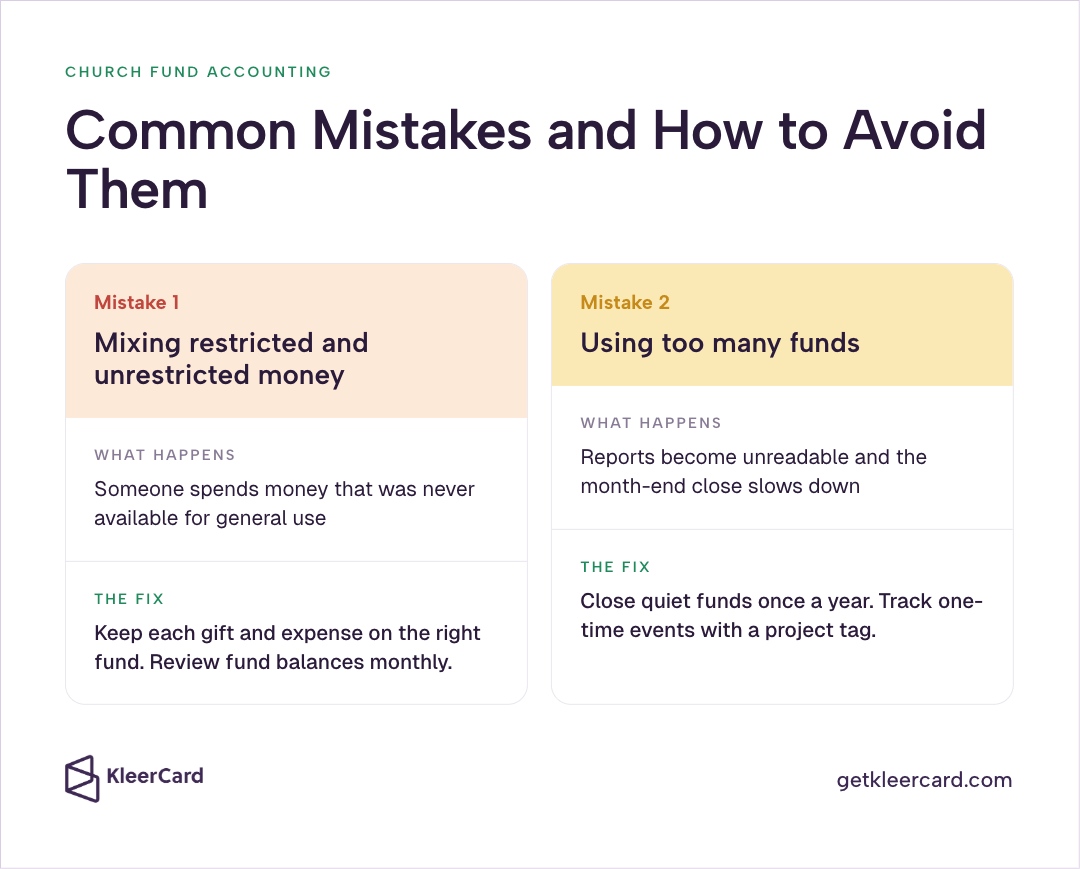
Most cleanup starts when restricted gifts get posted to the general fund, or when nobody wrote down how gifts should be assigned.
If church reports blend restricted and unrestricted balances, someone will spend money that was never available for general use.
Keep each gift and expense on the right fund and review fund balances monthly. Treat “we will put it back next week” as a transfer that still needs approval and a journal entry. The deposit can stay in one checking account as long as the reports still show each fund balance.
A new fund for every banquet, retreat, and microphone fundraiser makes reports unreadable and slows the month-end close. Review quiet funds once a year. Close the ones that no longer receive gifts or expenses.
A department or project tag can track a one-time event without opening another fund that needs its own balance.
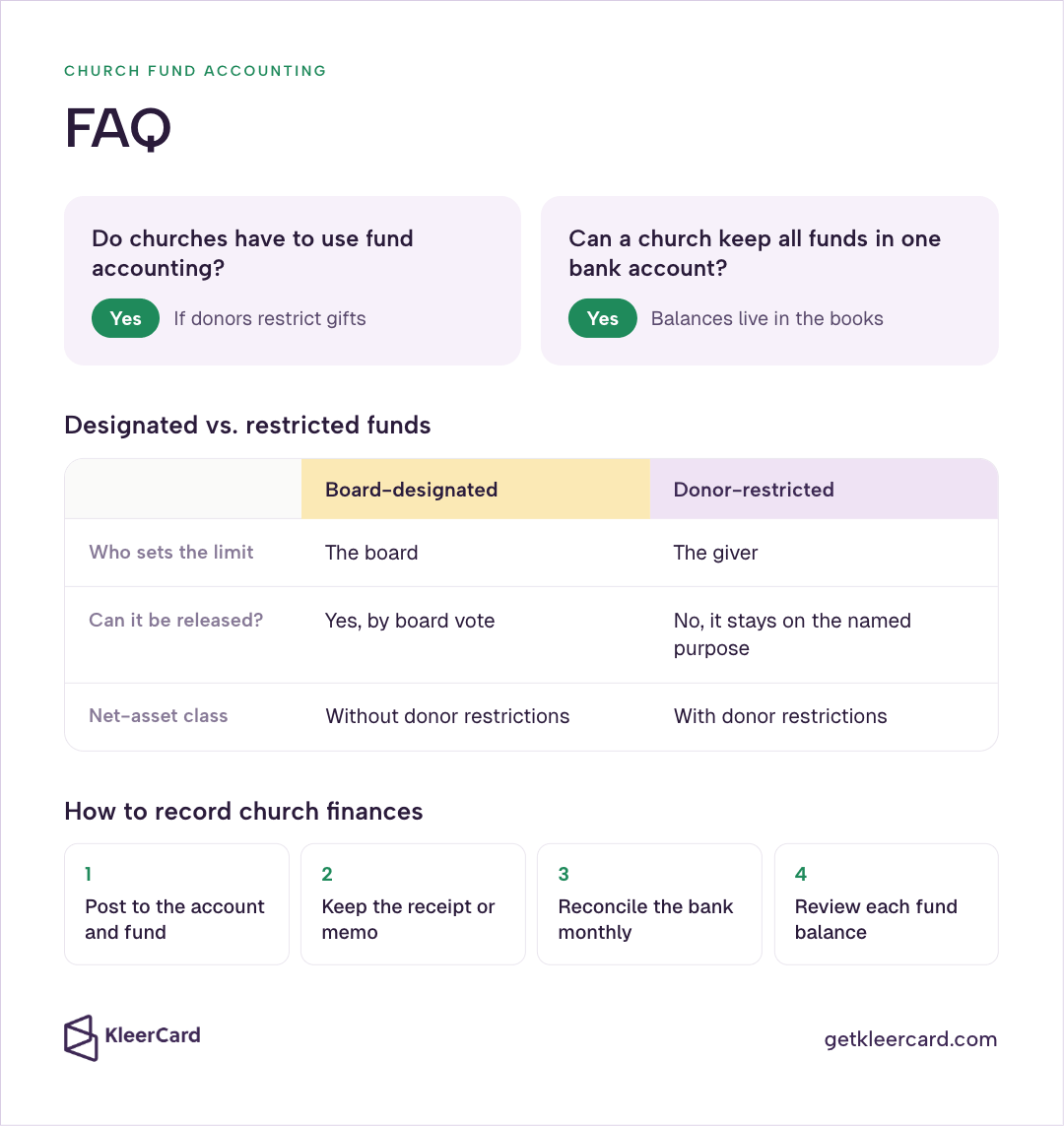
Yes, if donors restrict gifts by purpose or time. The books have to keep those balances separate from the general fund. Churches are not required to buy formal fund-accounting software, and most churches do not file Form 990. IRS Publication 1828 still expects records that support exempt status and donor intent. GAAP statements follow ASC 958 when an audit, a lender, or a denomination requires them. A small church with designated gifts still needs fund accounting, even if the tool is a simple ledger.
Yes. A church can keep every fund in one operating account; the fund balances still live in the books. Most churches already deposit tithes and designated gifts into that one account. Extra bank accounts add signers, board resolutions, and more reconciliations without fixing how gifts are assigned to funds.
A donor-restricted gift has to stay on the purpose the giver named. A board-designated reserve is unrestricted money the board can later vote to release.
Post each donation, deposit, expense, and transfer to the correct account and the correct fund, then keep the receipt or memo that supports the entry. Reconcile the bank monthly and review each fund balance before you send numbers to the board.

Church fund accounting starts with the funds already printed on the giving form: the general fund plus the two or three restricted purposes members actually give to. Close leftover event funds that no longer receive gifts or expenses. When the monthly reports go to the board, read each fund balance, not only the checking-account total.
For the wider finance system around those books, use the church accounting guide.


Speak to a member of our team and we can have you up and running in minutes, not weeks.